disinfection services
Disinfection Services for Metro Detroit Workplaces
Dwell time, the right chemistry, and the surfaces hands actually touch.
DITA Pro Clean provides disinfection services for workplaces across Macomb County and eastern Oakland County, targeting the surfaces that actually move germs between people. Door handles, shared keyboards, phone handsets, badge readers, break room appliance handles, treatment chairs and conference tables carry the traffic. Wiping those surfaces makes them look clean. Disinfecting them means applying a product matched to the material and leaving it visibly wet for the contact time printed on its label. That difference is the whole service.
Who this is for
This fits any workplace where people share space, equipment or air. Open-plan offices, medical and dental practices, physical therapy and chiropractic suites, urgent care and imaging offices, veterinary clinics, salons and barbershops, gyms and studios, schools and training rooms, call centers, and any business that lost a week of productivity the last time something went through the team. It runs as an add-on inside a regular contract or as a standalone visit.
Why businesses choose DITA
The step most cleaners skip is dwell time. Spray and wipe immediately, and the surface has been cleaned but not disinfected, because the product never stayed wet long enough to work. Our team is trained on the products we carry and the contact time each one requires, high-touch points sit as their own numbered line on the checklist rather than something caught while dusting, and product is matched to the surface material so we do not craze acrylic, strip a treatment chair vinyl or etch a natural stone counter. DITA Pro Clean is fully insured and every cleaner is vetted and background-checked.
How often do you need us?
Nightly for clinical, shared-equipment and public-facing spaces. Weekly for small teams. On-demand response visits when something has gone through the building, usually within a day for existing clients.
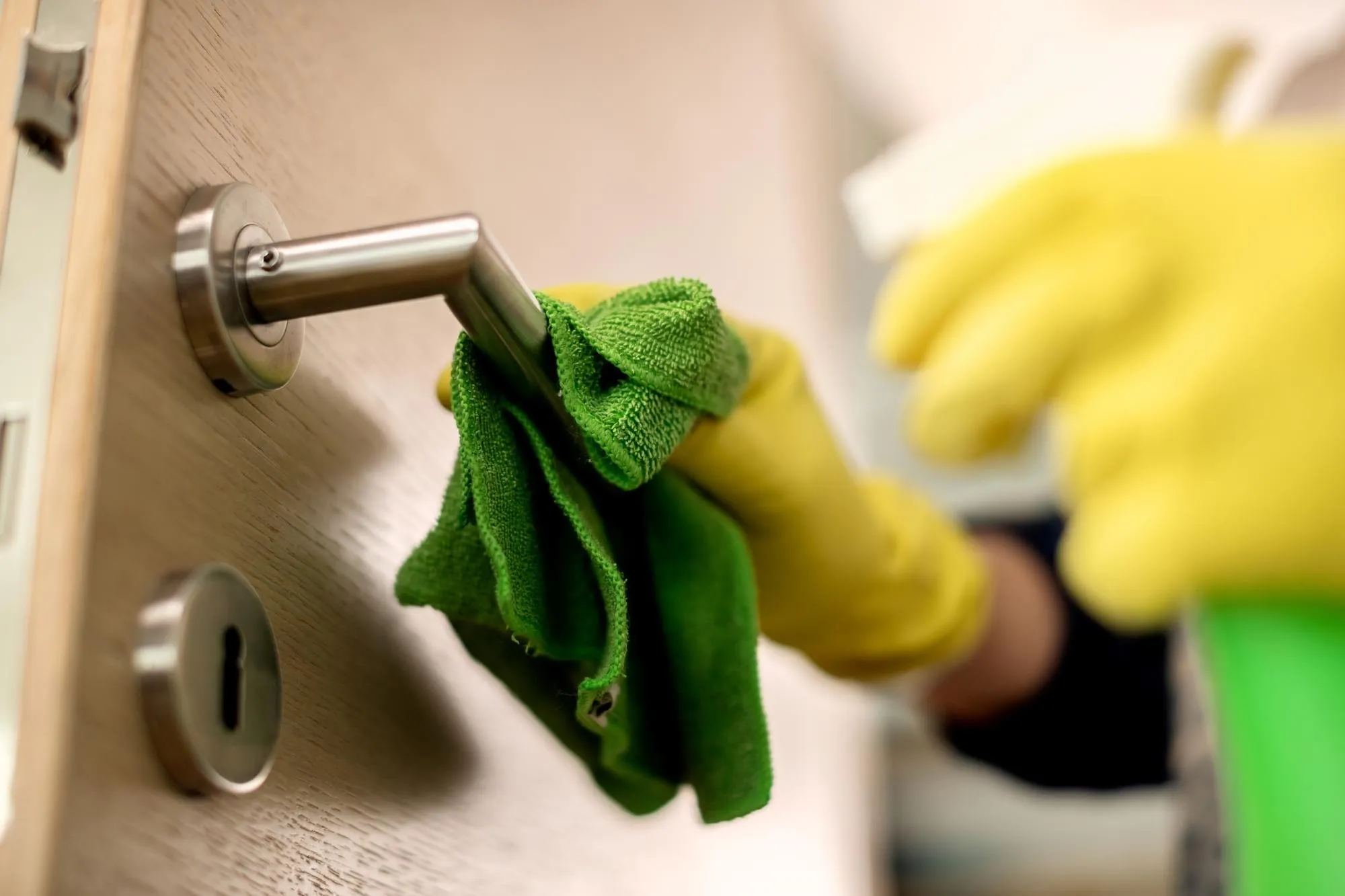
What's included in disinfection services
This is the checklist your team works from. We adjust it to your building at the walkthrough, and nothing on it is an optional extra.
- A mapped high-touch inventoryAt the walkthrough we count and list the touch points in your space by room, from door handles and push plates to badge readers, thermostats, handrails, elevator buttons and shared equipment, so nothing depends on a cleaner noticing it.
- Clean first, then disinfectSoil is removed before disinfectant is applied, because you cannot disinfect through a layer of grime. The two steps happen in that order on every surface, every visit.
- Correct dwell time on every surfaceProduct is applied and left visibly wet for the contact time on its label, then handled per the label. Surfaces that dry too fast get reapplied rather than counted as done.
- Chemistry matched to the materialQuaternary, alcohol-based, hydrogen peroxide and bleach-based products behave differently on stainless, laminate, acrylic, powder-coated metal, treatment vinyl, natural stone and electronics. We match the product to the surface so disinfecting does not damage the asset.
- Doors, traffic points and controlsDoor handles, push plates, panic bars, handrails, light switches, thermostats, badge readers, elevator buttons, appointment tablets and intercom panels.
- Shared equipment and workstationsKeyboards, mice, phone handsets, headsets, printer and copier touchpads, laptop docks, and cleared desk surfaces. Personal items stay exactly where you left them.
- Clinical and treatment room protocolsTreatment chairs and tables, arm rests, headrests, tray tables, cabinet pulls, light handles, sinks and dispensers handled to a written room protocol, with product choice agreed with the practice.
- Break rooms, restrooms and receptionRefrigerator and microwave handles, coffee machine buttons, tap and cabinet handles, counter edges, restroom dispensers and stall latches, front desk counters, sign-in tablets, pens and waiting room chair arms.
- Fragrance-free and low-VOC optionsFor treatment rooms, chemically sensitive staff and spaces where patients wait, we can run fragrance-free and low-VOC products throughout, agreed at the walkthrough and written into the scope.
- A record of what was treatedEach visit logs the rooms treated, the product used and the date, so a practice manager has something to show an inspector or a nervous client rather than a verbal assurance.
Available as add-ons
Scheduled alongside your regular visits, or booked as a one-off when you need them.
- Response visits after a confirmed illness in the building
- Electrostatic application for whole-room coverage
- Fragrance-free and low-VOC product programs
- Restocking of desk-side sanitizer and wipe dispensers
- Seasonal high-frequency schedules through respiratory season
- Locker room, studio and shared-equipment protocols
- Post-illness deep disinfection of a single department or suite
High-touch surfaces are where transmission happens
If you mapped how an illness travels through a workplace, it would not go through the floor. It would go through the entrance handle, the badge reader, the shared keyboard, the microwave button, the conference table, the coffee pot handle and the pen at reception. Dozens of hands touch those in a day and almost nobody thinks about them.
Each one takes seconds to disinfect properly. Each one is also the first item dropped when a cleaner is behind schedule, because nobody notices a skipped door handle the way they notice a full trash can.
So we treat high-touch points as their own numbered checklist line with its own sign-off, built from a count taken during the walkthrough. If it is a surface hands land on, it is on the list by room.
Dwell time is the step that decides whether this works
Every disinfectant carries a contact time on its label. That is how long the product has to stay visibly wet on the surface to do what the label claims. Depending on the product and the organism, that ranges from around 30 seconds to 10 minutes.
Spray, wipe, move on, and the surface is clean. It is not disinfected. The product never had time to act.
Our team is trained on the contact time of each product we carry. Product goes on, stays wet for the labeled interval, and is handled afterward as the label directs. Surfaces that dry early, which happens on warm metal and in low humidity, get a second application rather than a pass.
It is a small discipline. It is also the entire difference between a service that works and a service that looks like it did.
Matching chemistry to the surface
Disinfectant that damages the thing it is protecting is a bad trade, and it is common. Different chemistries behave differently on the materials in a real building.
Alcohol-based products flash off quickly, which makes them convenient on electronics and stainless, but they craze acrylic partitions, dry out and crack treatment chair vinyl over time, and often evaporate before their own contact time is met. Bleach-based products are effective and cheap, and they pit stainless, corrode metal fixtures and bleach fabric and grout. Quaternary products are gentle on most hard surfaces but can be deactivated by soil and by some cloth fibers. Hydrogen peroxide products suit clinical spaces and most hard surfaces with less material risk. Acidic descalers belong on restroom fixtures and will etch natural stone counters in a reception area.
We record the materials in your building at the walkthrough, including counter substrates, partition material, treatment upholstery, cabinet finish and any natural stone, then assign products by surface. Cloths are color-coded so a restroom cloth never lands on a break room counter.
Fragrance-free and low-VOC for medical and treatment spaces
A treatment room that smells strongly of disinfectant is a problem for the practice. Patients arriving with respiratory conditions, chemical sensitivity or migraine triggers notice it immediately, and staff spending eight hours in it notice it more.
Fragrance-free and low-VOC products are a standard option here rather than a special request. They cover medical and dental practices, physical therapy and chiropractic suites, veterinary clinics, salons and any office with staff who react to scented chemistry.
The product list is agreed with you at the walkthrough and written into the scope. That matters, because the usual failure is a substitution nobody was told about. If a product on your list is unavailable, we ask before swapping it.
Clinical and treatment room protocols
Treatment spaces get a written protocol per room rather than a general instruction. Chairs, headrests, arm rests, tray tables, light handles, cabinet pulls, sinks, dispensers and the specific surfaces a practice designates all appear by name, with the product and the contact time next to each.
Each visit is logged: the rooms treated, the product used and the date. A practice manager can show that record rather than describe a routine.
When to book a response visit
Regular disinfection reduces routine transmission. A response visit deals with a specific event: a confirmed illness in a department, an outbreak that has moved through a shift, or a patient event in a treatment room.
Call or text and we schedule it, usually within a day, with existing contract clients prioritized. We treat the affected rooms plus the shared surfaces connecting them, because the corridor handle and the break room refrigerator are how something reaches the rest of the building.
How this fits with our other commercial work
Disinfection is already part of the high-touch line in our office cleaning scope, so you are not buying it twice. Businesses book it separately when they need clinical protocols, documented product lists, fragrance-free chemistry, higher frequency through respiratory season, or a response visit. Buildings on a contracted janitorial services program carry it as a scheduled line inside the scope of work.
The overview of everything we do for businesses sits on commercial cleaning services.
Where we provide disinfection services
We serve workplaces across Macomb County and eastern Oakland County, including Sterling Heights, Clinton Township, Macomb Township, Warren, Chesterfield, Washington Township, Utica, New Baltimore, Troy, Royal Oak, Rochester, Rochester Hills, Birmingham, Grosse Pointe and Detroit. Medical corridors in Detroit and Clinton Township have their own pages.
To start, call or text (248) 971-4886 or email [email protected].
Near you
Disinfection Services across Metro Detroit
Looking for disinfection services near you? We run regular routes through the cities below, plus the surrounding Macomb and Oakland County communities.
Good to know
Disinfection Services, your questions answered
What is the difference between cleaning and disinfecting?
Cleaning removes soil and most of what is sitting on a surface. Disinfecting kills what is left. They happen in that order, because a disinfectant cannot reach through a layer of grime. Our regular commercial cleaning does both. This service is about doing the disinfecting step thoroughly and consistently on the surfaces that carry the most hands.
What does dwell time mean and why does it matter?
Dwell time is the contact time printed on a disinfectant label, the number of seconds or minutes the product must stay visibly wet on a surface to work. Common commercial products range from about 30 seconds to 10 minutes. Spray and wipe straight away and you have cleaned the surface without disinfecting it. Our team applies product, leaves it wet for the labeled time, and reapplies where a surface dries early.
What products do you use?
Commercial disinfectants applied according to their label directions, chosen to suit the surface. Alcohol-based products flash off fast and suit electronics but are wrong for acrylic. Hydrogen peroxide products suit clinical settings and most hard surfaces. Bleach-based products are reserved for specific jobs because they damage metal and fabric. If your space needs fragrance-free, low-VOC or green-certified chemistry, we build the scope around it.
Can you use fragrance-free products in a medical office?
Yes. Fragrance-free and low-VOC chemistry is a standard option for treatment rooms, waiting areas and practices with chemically sensitive patients or staff. We agree the product list with you at the walkthrough and write it into the scope, so a substitute never arrives without your knowledge.
Can you come in after someone has been sick?
Yes. Call or text and we schedule a targeted disinfection visit, usually within a day. Businesses already on a regular schedule with us get priority. We treat the affected rooms and the shared surfaces connecting them rather than only the desk where the person sat.
Do you move things on people's desks?
No. We clean and disinfect the clear surface area around personal items and we do not move paperwork, files or equipment. If your team clears desks at the end of the day, coverage improves, but that is their choice rather than a requirement.
Will disinfectant damage our equipment or finishes?
Not when the product is matched to the surface, which is why we record materials at the walkthrough. Alcohol crazes acrylic and dries out treatment vinyl. Bleach pits stainless and corrodes metal fixtures. Acidic products etch natural stone. We note the finishes in your building and assign chemistry per surface rather than carrying one bottle for everything.
Next step
Get a quote for disinfection services
Tell us about your building and we will price the real scope, with no per-hour guesswork and no package designed to sell you more than you need.
Prefer to talk it through? Call or text (248) 971-4886 and you will get Dita, not a booking app.
Call or Text: (248) 971-4886Free quote, Disinfection Services
One business day for a reply, usually much sooner. No obligation and no follow-up you did not ask for.
In a hurry?Call (248) 971-4886Text us
Other commercial services
Most clients combine several of these on one schedule and one invoice.
We Keep Your Home Spotless.
Ready for a spotless workplace?
Tell us about your building and we will put together a free, no-pressure quote for disinfection services. Most quotes are back with you within one business day.